The Other 5 Elements

Fundamentals continued…

pages 14-20

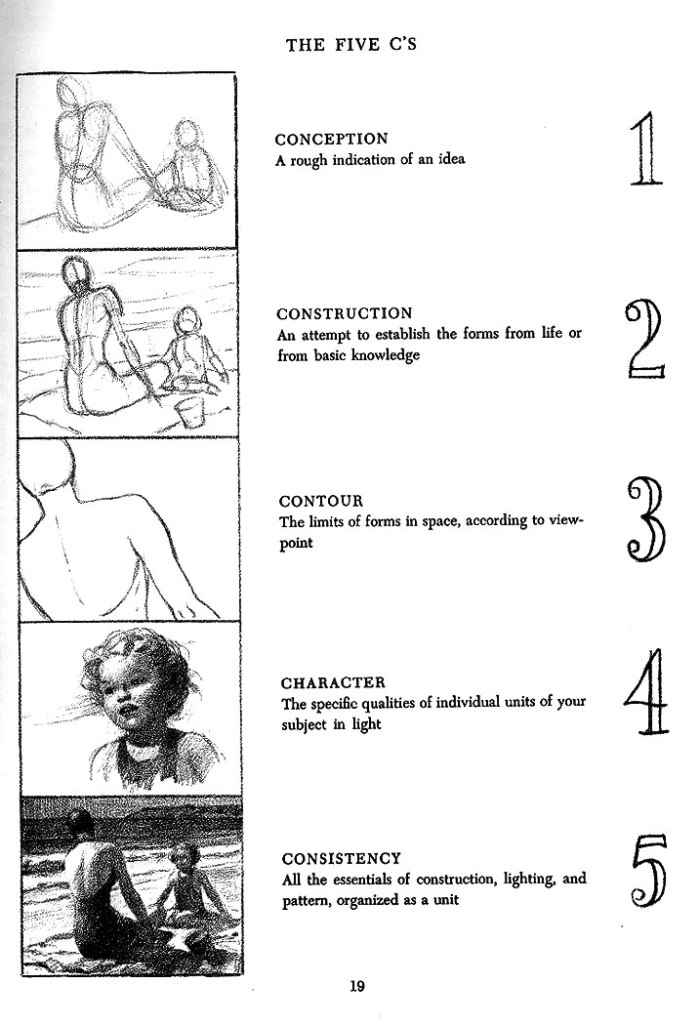
Following the Five P’s, Andrew Loomis gives us five more essential elements which are integral to Successful Drawing.  These five all begin with the letter ‘C’, and are so called the Five C’s. Where the Five P’s were formal concerns, tending toward the technical, the Five C’s include 2 elements that are more of a philosophical nature.  The remaining 3 terms are further technical concerns.

The Five C’s:

  1. Loomis advises artists to close their eyes prior to commencing drawing, and to imagine the subject which they intend to draw. He adds that the subject should be thought of in connection to the basic purpose that the artist is trying to achieve in doing the drawing.  He terms this the CONCEPTION of the subject.
  2. As soon as the Conception is made, immediately the artist is faced with the challenge of putting his Conception down correctly on the paper.  That image conception may be crystal clear, or hazy in one’s mind, but regardless of which, the committing of  vision to paper is another thing.   Loomis groups all of the methods an artist may use, including  working from photo references to live model sittings to building an image from sketches, as within the second category CONSTRUCTION.  Considering the Construction of a thing represents the artist’s efforts at understanding the mass and the bulk of whatever he is trying to represent.  Construction is based on view point and perspective.
  3. The sibling of Construction is CONTOUR, that is the outer edge of a mass in space.  Loomis indicates that Construction and Contour are indivisible, and one cannot be achieved properly without the other.
  4. Moving into the less specific, Andrew Loomis adds CHARACTER as the fourth essential element.  He states: ” Usage brings character to an object; experience brings it to man.”  When attempting to represent a thing, be it living or inanimate, the more accomplished artist is able to capture its Character.  What Loomis means in regards to capturing Character is when artwork achieves more than verisimilitude with reality.  A drawing which seems able to represent that intangible aspect which is singular and belonging to the one subject represented -and to no other- is when Character has been achieved.  As an afterthought, Loomis adds that in portraiture, Character is paramount, and it depends on an understanding of placement, planes and contour.
  5.    Andrew Loomis is not hesitant to label this last point the most important of all of the elements.  The final element is CONSISTENCY.  This element is the umbrella element in some ways, in that it is the expression of ALL of the elements in concert, from the P’s through the C’s.  Each of these 10 Elements need to be in a state of non-contradiction. Loomis advocates for a consistency of technical understanding, competency in usage of media, and artistic purpose expressed throughout the artwork.  This means having a handle on all of the elements, and letting them work through one’s act of drawing.  He ends with this quotation: “The artist cannot go wrong when he can see the big truths”
Loomis-5-c's.jpg

As a wrap up, Andrew Loomis explains to us that the failure of a drawing is nothing more than the failure in one or more of these 10 Elements.  He roundly encourages us to focus on the 10 Elements and not on artistic message or on trying to achieve saleability.  The reason being that both expression and sales are made so much more difficult when an artist does not understand how to draw.  Everything begins with learning the fundamentals of SUCCESSFUL DRAWING.

The 5 Elements of Good Drawing

Fundamentals continued…

pages 11-13

There is a great deal of fabulous information in the text of Andrew Loomis’ books, and those who jump straight to his wonderful drawings without taking the time to read his words miss a lot.

Following the general talk about what makes artwork appealing, including his theory of intelligent perception, Andrew Loomis begins to talk in earnest about the actual elements of good drawing, though he is still maintaining a philosophic position at this point; the actual technical instruction, and ‘how-to’ section of the book is yet to come.

Here, Loomis introduces the reader to the key elements which are necessary to create a convincing piece of representational art.  He boils the elements down to 5, and emphasizes that they are the essential frameworks for the conception of a drawing.  What he means by conception is none other than the successful expression of an artist’s sense of life.

He creates an elegant method of recalling the 5 elements, in that he establishes 5 terms which all begin with the letter ‘P’.  The terms become known as the Five P’s.

Here they are:

  1. When one considers the drawing of any subject, it must be noted that all objects are dimensional; that they have height, breadth and thickness.  Furthermore, there is a ratio between these dimensions, and when those ratios add up in a drawing we have a convincing representation.  A drawing cannot be good when the ratios are not proportional, so the first element is PROPORTION.
  2. Every drawing is a puzzle, and choosing where to place subjects within the boundaries of the paper’s edge constitutes the consideration of  the second element which is PLACEMENT.  
  3. All drawing needs to be related to an horizon.  When an artist does this correctly, he is engaging in the technique of drawing called PERSPECTIVE.
  4. Everything we can perceive with our sense of sight is made possible by the degree of light which falls on it.  Where there is light, there is shadow, and in order to understand how to render light, the artist can break an object into PLANES.
  5. The placement of an object constitutes only half of the visual puzzle, the other half is related to the lights and darks and the textures .  When an artist considers the working out of these factors, he is considering PATTERN.  Pattern is to tonal areas as placement is to line work.

Loomis-5-p's


Following his outlining of the Five P’s, Loomis advocates for the drawing of thumbnails, where the elements which he has given us are to be worked out over the course of multiple sketches.

He is also quick to state that these Five Elements are not the only elements needed for good drawing.  How does one learn these additional elements of good drawing?

Do not worry dear reader, Andrew Loomis brings them into our aquaintence in the following section.


Intelligent Perception

Fundamentals continued…

pages 11-13

The next major idea Andrew Loomis considers is what he calls Intelligent Perception.  This concept is central to Loomis’ idea regarding why some art appeals and why some does not.  His position is that each and every person has a highly-developed ability to perceive what is real and what is fake.  Any common person can tell a store mannikin is not a real person, or that a stuffed animal is not alive.  In certain cases where the ability to perceive is confused, such as in a very convincing magic trick, the viewer is amazed and pleased.  When something is trying to be passed off as legitimate, and the viewer is not convinced, it is their ‘intelligent perception’ which is providing the alarm bell.

Loomis elaborates that every person, whether they are aware of this or not, are specialists at knowing reality.  He maintains that access to this kind of perception is automatic and unconscious.  Willful disregard of reality is possible, but this is evasion of what your senses tell you, and such efforts place one’s consciousness as a primary before what is real.  This is not so. Since the world is not a figment of our minds, our minds are within an actual existing world.  The primacy is not of our consciousness, but of existence, of reality -regardless of whether we are there to perceive it or not.

He says:

At some time or other, our brains accept certain effects or appearances as truth, and abide by these decisions. We learn to distinguish one appearance from another, in size or proportion , in color, and in texture.  All the senses combine to give us intelligent perception.  We have a sense of space or depth, even if we know nothing of the science of perspective.  We are quickly aware of distortion or deformity, since the appearance does not coincide with what experience has taught us is normal or truthful.  Form is registered in the mind, even if we know nothing of anatomy and proportion, so that we recognize a face immediately, though we could not even give a good verbal descriton of it.  Our sense of proportion tells us that this is a child and that is a midget, or this is a puppy and that is a small dog. Intelligent perception includes a feeling of bulk and contour.  We know a swan from a goose, or a goose from a duck.  …such perception is part of nature.

From the moment that the infant is aware of the world around him, he begins to be trained to differentiate and classify things. This begins out of a necessity to make order out of the barrage of sensory stimulation he is faced with.  The process is automatic and natural, as it is how the mind primarily functions -as a tool of order and of classification.  The classification of a recliner into the category of chairs and not into the category of beds is the hallmark of our brain’s method of ordering and recognizing our percepts (meaning what we perceive).  The senses perceive a thing, then the brain automatically weighs that data against the entirety of data it has stored.  When a series of ‘matches’ are made with a certain concept category, such as chair, the process of recognition occurs.  Finally, the viewer says, “that is a chair I see”.

The formal qualities of a chair are constant, but the measurement is abstracted, so that toy chairs and drawings of chairs or giant chairs still register in our consciousness as ‘chair’.  This is what Loomis is pointing out when he is emphasizing our automatic ability to recognize and differentiate swans from geese etc.

After understanding this concept, it is easy to extrapolate why even non-artists are able to recognize poorly executed representation.  When a viewer spots a distortion in proportion, or an unnatural change in lighting or form or colour or texture, he realizes that there is a mistake.  There is no way to fool intelligent perception, and everyone knows a fraud.  Everyone knows the myriad effects of reality, such as the effects of light on skin, and a fraudulent representation will not fool us.  The copious strands of this data have already been registered in our minds just by our being perceptive within reality.

Consider this final quotation from Loomis:

Intelligent perception finds only truth convincing.  The layman does not need to know anything of art to know whether he likes your work or not.  We can use all the arguments, alibis, and defences in the world;  we can explain ourselves hoarse, but we cannot affect something so deeply imbedded in human consciousness.  If what we say in paint is untrue, in color values or effect, the spectator feels it, and there is nothing we can do to convince him otherwise.

Real date                                                                            Not a date

Fundamentals


Chapter, the first

Successful Drawing

A short note about philosophy

Throughout these reviews, I will refer to a concept is called “a sense of life”.  The words ‘sense of life’ stand for a suite of ideas representing a person’s outlook on existence and the forces which move the world.  It is more than a point of view though, in that a sense of life unconsciously underscores and shapes the volitional essence of every choice and action one takes -in or witnesses.

A sense of life defines not only a person’s belief system, but also his character.

The reason I have started with a definition of the concept sense of life, is that Andrew Loomis was philosophical.  He recognized that ideas matter and that knowledge matters.  He believed in truth, and the power of man’s mind to discover that truth.  Through his constant observation of reality, and because of his desire to define a method of representing that reality, Andrew Loomis naturally developed a set of philosophical and technical guidelines for illustrators to follow.

In the following sections, you will find my notes and elaborations which were composed after I had generally read Successful Drawing, and had gone back to begin actively studying  the book as an instructional manual.  The dates for these notes are January 5th and 6th of 2016.

The Fundamentals of Successful Drawing

pages 11-13

The first pages of every Andrew Loomis book begin by outlining the basic principles which he keeps regarding art and drawing in particular.  Loomis’ sense of life is positive; that the world is beautiful and that humans are good.  In this, he is taking part in the conception of art from the Classical period.

Successful Drawing especially emphasizes Loomis’ conception of a ‘benevolent universe’, i.e. that there is no pernicious force at work which seeks to keep man down.   Loomis believes that answers to problems do exist, and that they are ready to be found.  Furthermore, he maintains that their discovery is a matter of careful study and a result of one’s adherence to reality.

The first paragraphs outline how successful drawing is a result of true analysis of the world, that is, what is real.  One achieves this through perception.  To elaborate, the concept which he is establishing shows that an artist can not represent reality if they do not know it, or do not seek to observe it.  This stance puts Andrew Loomis firmly in the category of a representational artist, and eschews any discussion of non-representation in art.

He takes for granted that what an artist is doing is trying to represent what is real.  Art must be recognizable so that another viewer can observe and read the work. He also believes that an artist’s job is not to merely record or report on reality, as per a journalist or a scientist.  He sees the choice of what is represented as indivisible with the nature of the artwork, as well as with the nature of the artist.

It is important to recognize that Loomis implicitly believes that representational art is not to be interpreted as reality.  Instead, representational art is a declaration of choice; the choosing to show a representation of one momenatry aspect of reality.  It is a representation of the world as through the lens of the artist’s eyes, so that the viewer may see in proxy. Viewers of art are able to glimpse through their contemplation of a work the artist’s sense of life . Observation and recording of reality is essential, but artistic vision is what makes the product of one’s work into art, rather than journalism.

Thus, his formula is that true observation coupled with an positive artistic sense of life is what constitutes worthwhile art.


Understanding Loomis

Meet Andrew Loomis, illustrator

My favourite drawing instructor and artist in general is Andrew Loomis.  He was an American illustrator who worked at the tail end of the Golden Era of illustration.  His contribution of elegant illustrations were used in commercial ads, book covers and magazines, but he was also a highly respected instructor of art during his career.  The observations and facts about technical illustration and drawing which Loomis made throughout his career were collected in a series of books  from 1939 to 1961.  These books cover every facet of illustration theory and technique.

The books themselves are indespensible resources and should be owned individually, but that being said I might add that some of the concepts within the breadth of the works are difficult to integrate for general readers as well as for students of art.  Thus, to help clarify these essential concepts of drawing, I have endeavoured to develop this blog which I have entitled Understanding Loomis.

My purpose is twofold here, the lesser of which is to generate a companion piece to Loomis’ writing for other artists to read at any level.  The primary purpose of this blog is for my own study, so that I may come to fully integrate the concepts which Loomis is explaining in his books within my own mind.

Successful Drawing

51J8sR5Z6DL._SX361_BO1,204,203,200_

I will begin the systematic review and breakdown of Andrew Loomis’ writing with the late-entry publication entitled Successful Drawing, from 1951This book appeared chronologically near the end of Loomis’ career, and although he started coalescing his concepts and discoveries into book format at the end of the 30’s, Successful Drawing is a good place to begin.  This title was re-released in a slightly altered form in 1961 as Three-Dimensional Drawing.

The reason I will begin here is that I have found Successful Drawing to have the best balance between drawing fundamentals and art theory.  It should be said at this point that readers will find art theory to be more emphasized within the writing of Andrew Loomis than is commonly found in most other instructional works.  The principle which Loomis takes as a starting point is that there is no division between theory and practice, and that to harbour a vague understanding, or a contradictory theory of art will only lead an artist into struggles which should have been avoidable.

The sense of life he has is positive, objective and technical to the point of mathematic.  I find this approach to be a very, very welcome panacea to the confused mindset of artists steeped in Fine Art-school ideology and those unquantifiable art theories which place their emphasis on expression, creativity and “meaning”.  Loomis focuses on the tangible and mechanical elements  of art which -as he promises- can be learned, and will yield a correct representation of reality.  This is most valuable in that these are terms which an artist can control and can learn through attentive practice.

Next posting I will commence with the actual breakdown of Loomis’ writing, where we will begin with his outline of the fundamentals needed to start on the journey toward Successful Drawing. 

I hope that you can join me.  In the mean time, enjoy these samples from Andrew Loomis.